
The Generational Wealth Code: 3 Millennial Lessons for the 21st Century Entrepreneur
Descripción deIn a world where the average "entrepreneur" is tethered to their business, chasing every sale and putting out daily fires, one question resonates with particular force: Why have certain groups, throughout history, seemed to crack a different code for prosperity? We aren't talking about luck, secret handshakes, or unfair advantages.
L. D.
2/2/20265 min read

we are talking about an Architecture of Thought—a mental operating system that transforms economic survival into generational dominance.
While most business owners in LATAM, the United States, and Canada play to pay the month's bills, the true Wealth Architect plays to design the freedom of the next three generations. This is not a "get rich quick" philosophy; it is a millennial strategy for building an impregnable estate, a legacy that transcends you.
In this article, we will break down the three fundamental pillars that have allowed certain communities to not only survive economic cataclysms but to thrive, turning their businesses into bunkers of freedom and sources of perpetual capital. If you are tired of being the motor of your own machine and want to become the architect of a limitless future, this is the code you have been looking for.
1. The Talmudic Rule of Diversification: An Ancient Blueprint for Modern Wealth
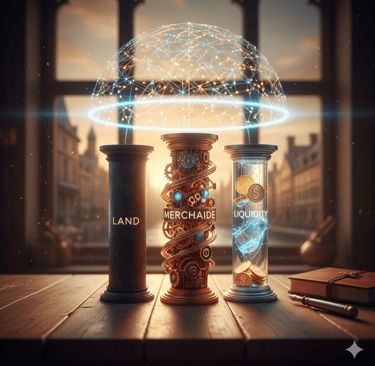
Imagine a text written over 1,500 years ago containing an investment formula that Wall Street still tries to emulate today. The Talmud, a compendium of Jewish wisdom, dictates a surprisingly simple yet unbreakable rule for asset management: "A man should always divide his money into three parts: a third in land, a third in merchandise, and a third ready at hand." This is not religious advice; it is a principle of financial resilience that is more applicable today than ever for the global entrepreneur.
One-Third in Land (Real Estate and Physical Assets): Unshakable Security. In an ancient context, "land" meant stability. Today, this translates into strategic real estate, infrastructure investments, or tangible assets that retain value. Physical assets are an anchor against inflation and financial market volatility. They are the foundation upon which the rest of the empire is built. For the 21st-century entrepreneur, this might include everything from a diversified REIT portfolio to owning the physical servers for your digital infrastructure, ensuring fundamental control over the resources you use.
One-Third in Merchandise (Your Business, Systems, and Cash Flow): The Growth Engine. "Merchandise" represents the engine of your economy. This is where your LLC (Limited Liability Company) comes to life. It is the capital that, while inherent to controlled risk, has the potential to generate the highest cash flow and the fastest expansion. This third is where you invest in your systems, your team, your marketing, and the creation of products and services that solve real market problems. It is the "sales machinery" we have discussed—the asynchronous system that invoices while you sleep. It is active capital, tirelessly working to multiply itself.
One-Third Ready at Hand (Liquidity and Reserve Capital): The Ability to React and Seize Opportunity. "Ready at hand" is your lifeline and your springboard for new opportunities. It means having liquid, accessible, and crucially, protected reserves in secure jurisdictions. In the world of L.D., this translates into cash in high-solidity banks, very short-term bonds, or stable currencies (like USD or EUR) that allow you to act quickly. When the market suffers a "Black Swan" event—an unexpected, high-impact event—this third allows you to buy depressed assets at bargain prices while others are forced to sell. It is the manifestation of patience and long-term vision.
The Architect’s Lesson: Never put all your eggs in one basket—not even the basket of your own business. A true financial architect builds on three interconnected pillars, ensuring that if one fails, the other two hold the structure. Diversification is not just an investment strategy; it is a philosophy of survival and growth.
2. Social Capital: The Architecture of Global Trust
In a world obsessed with hundred-page contracts and constant audits, the concept of "trust" has become a luxury. However, for the creation of generational wealth, Social Capital—the network of relationships based on trust and mutual respect—is as valuable as any bank account. Communities like the Jewish one have perfected this art for centuries, drastically reducing "transaction costs" and accelerating the flow of capital and opportunities.
Less Bureaucracy, More Speed: When you do business with people who share your values, your work ethic, and your long-term vision, the need for excessive intermediaries decreases. A person's word and reputation are stronger than any legal clause. This translates into faster decisions, less paperwork, and ultimately, a much more agile and efficient business machinery. For the global entrepreneur, this is a brutal competitive advantage.
Invisibility is Not Isolation: As L.D., you operate under a pseudonym, prioritizing privacy and efficiency. This does not mean isolation. Your true currency is your technical reputation, the quality of your work, and the consistency of your principles. An architect is not invisible because they are hiding, but because their system speaks for them. Your network is not based on facial recognition, but on the validation of your results and your ethics.
The Business Community as an Ecosystem: Creating sustainable wealth is not a solitary act. It’s about building an ecosystem of other "Architects" who operate under the same standards of excellence and trust. These networks become sources of capital, talent, ideas, and protection. If your network is solid, your business is inherently anti-fragile, capable of absorbing shocks and emerging stronger.
The Architect’s Lesson: The most valuable asset you possess is not your bank account or your client portfolio, but the quality of the people you surround yourself with and the depth of the trust you build. Invest in your network; it is the fuel for your generational engine.
3. Iron Education: The Brain as a Wealth Bunker
Wealth is not measured by what you own, but by what you are capable of creating, rebuilding, and understanding. In cultures where wealth has been historically precarious due to persecution or instability, investment in knowledge and financial literacy became an impregnable bunker. A child is not taught to "save"; they are taught to invest and generate value.
Assets Over Consumption: A Philosophy of Life. The average entrepreneur, upon experiencing their first success, tends to buy liabilities that enslave them: luxury cars, ostentatious houses, unnecessary gadgets. The Wealth Architect, instead, invests in assets that generate more income. If they want a luxury car, they first build a system that pays for that car, and then another system that pays for the maintenance and insurance. The key question is always: "Will this generate more money for me or cost me more money?"
Perpetual Investment in Knowledge: The only asset that no one can confiscate, that does not depreciate, and that multiplies over time, is your brain. Your ability to learn, adapt, and apply new knowledge is the most powerful source of wealth. Even if your LLC were forced to close tomorrow, your ability to rebuild the machinery from scratch is what truly makes you wealthy. Wealth is not in the bank account; it is in the mind that created it.
Liabilities vs. Assets in Your Time: Apply the same logic to your time. Are you consuming your time on operational tasks that others could do, or are you investing it in strategy, learning, and building new systems that will set you free in the future?
The Architect’s Lesson: Your financial education and your ability to think strategically are your most valuable assets. Invest in them with the same discipline you invest in your business. True freedom is not having money, but knowing how to generate it at will, even in the most adverse circumstances.
Conclusion: Are You the Owner or the Engine? The Legacy of the Invisible Architect
Generational wealth only materializes when the business ceases to depend on your physical presence. When the "machinery" you build has a life of its own, backed by systems, a network of trust, and an unshakable mindset, then you will have transcended the self-employment trap.
Millennial principles are not relics of the past; they are the blueprints for building the future. They teach us that the ultimate goal is not "working hard," but building assets that work tirelessly for us and for the generations to come.
L.D. invites you to stop being an operator of your own destiny and start, today, to be the architect of your freedom. The code has been cracked; now it is your turn to build the empire.